

The Employment Rights Act 2025 is widely being viewed as the biggest shift in UK employment law for decades. Since Royal Assent on 18 December 2025 there have been a raft of changes which have already reshaped employer obligations and implementations dates for further changes are on the horizon.
To help you ensure that you are ERA ready, our team of experts are providing an ERA Audit for £475 + VAT. Get in touch on 0203 667 5400 or hello@weareloch.com to learn more and book yours. Our ERA Audit will help you pinpoint your most urgent risks and give you a tailored, prioritised action plan.
You can also watch our recent webinar on-demand, download our comprehensive ebook and Q&A.
Why 1st July 2026 is a date to take notice of
Employees recruited on or after 1 July 2026 will be among the first cohorts to gain the new unfair dismissal rights. From 1 January 2027, the qualifying period for ordinary unfair dismissal protection will be reduced from two years to six months, and the compensatory award cap will be removed.
For employers, this makes recruitment, onboarding, probationary periods and probationary period management a business critical priority now, not something to revisit once the rules are already in force.
This article is based on Loch’s recent webinar, The Employment Rights Bill: What employers need to know, delivered by Lauren McLaughlin (Partner and Employment Solicitor), Victoria Regan (Partner and Employment Solicitor) and Laura Acosta (Senior Training and Wellbeing Consultant). Aimed at forward thinking leaders, the session focused on how to stay compliant and build a more successful, meaningful organisation as employee rights evolve.
To help get you ERA ready, you can watch the webinar on-demand, download our comprehensive ebook and Q&A, or find out about our ERA Audit provided by our experts, below. Or, if you want an overview of some of the key reforms, keep reading…
Why the Employment Rights Act changes the day to day for employers
A key theme from the webinar was that this is not “policy tweak” territory. The Employment Rights Act represents a substantial reset in how organisations recruit, manage, support and, where necessary, dismiss employees.
The reforms are not landing in one “big bang”. They are being phased in across 2026 and 2027, with some changes already in force and others still subject to further detail. For many employers, even those who have already implemented significant policy and practice changes to date, the current immediate commercial risk now sits with new starters, but for others the imminent changes to harassment and sexual harassment protections present a pressing need for changes in behaviours and processes.
Key date: 1 July 2026 – an important date for new hires
For employers, reducing the qualifying period for ordinary unfair dismissal from two years to six months, is one of the most operationally challenging reforms.
It will apply to all those employees who have 6 months’ service as at 1 January 2027; i.e., those hired on or after 1 July 2026. This changes the risk profile for hiring decisions made this summer and beyond.
Employers will have a much shorter window to identify whether a new recruit is right for the role, putting the spotlight firmly on processes, documentation and manager capability, which will either protect your organisation or expose it.
Recruitment, onboarding, probation and early performance management should all be structured, consistent and properly documented so that concerns are addressed early, and decisions are supported by clear evidence.
Key date: 30 October 2026 – an important date for extending obligations to prevent harassment and sexual harassment
Employers will have to ensure that policies and practices are set up to ensure “all” reasonable steps are taken to prevent sexual harassment, and third party harassment.
The range of measures that may be taken to demonstrate that “all” reasonable steps have been taken may be wide, including updating policies, reporting and investigation channels and making clear to third parties, including clients, that harassment of employees will not be tolerated.
Need help getting your recruitment, onboarding, probation ot harassment and sexual harassment protection processes ready for the new ERA risk landscape? Get in touch on 0203 667 5400 or hello@weareloch.com to learn more about our ERA Audit, priced at £475 + VAT per corporate entity.
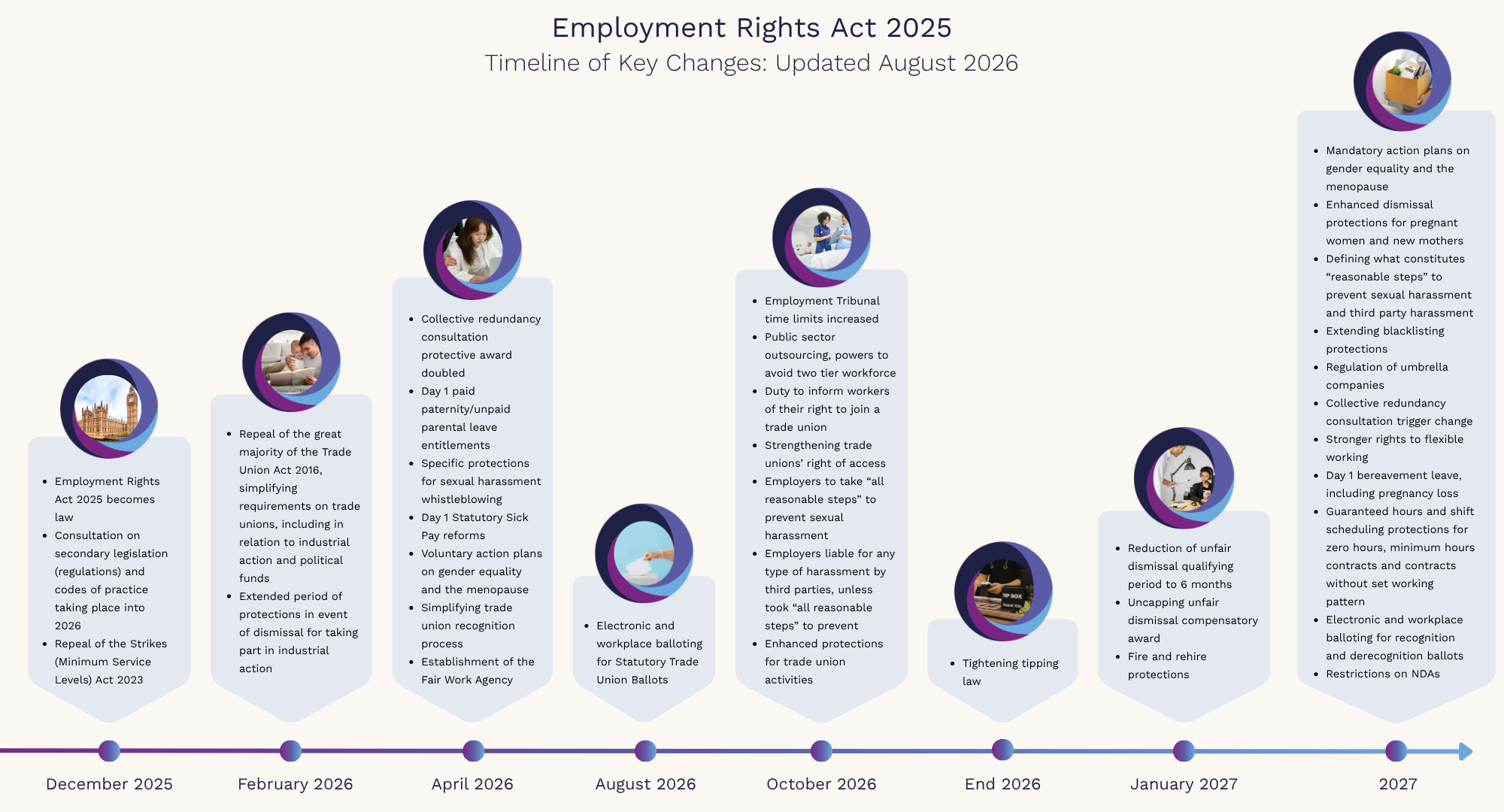
Changes already shaping employer responsibilities: review of reform dates
With some changes yet to be implemented, employers should not lose sight of the significant reforms already introduced.
A small set of reforms landed in February 2026, focused on industrial action and trade union law. These won’t affect every employer day to day but are relevant for organisations with a union presence.
April 2026 saw the first wave of major changes under ERA, including:
1) Statutory Sick Pay becomes a day one right
In the webinar, Victoria highlighted a material shift: SSP is payable from day one, with the waiting days removed and the lower earnings limit removed, bringing many more workers into eligibility. That means higher cost exposure, but also a bigger administrative burden.
Set your organisation up for success: review absence policies and reporting, test payroll readiness, and strengthen absence management so you can address root causes (culture, workload, management behaviours) rather than simply processing higher sickness volumes and more costly SSP payments.
2) Family-friendly rights: day one changes
The webinar also highlighted family-friendly reforms moving sooner than many employers expected. From April 2026, paternity and parental leave are day one rights. Bereaved parent paternity leave is also now a day one right, entitling a bereaved parent to up to 52 weeks of unpaid leave.
Set your organisation up for success: The reforms increase the need for clear and compliant policies, consistent manager decisions and payroll/leave processes that stand up to scrutiny.
3) Collective redundancy risk increases
If you’re planning a restructure, the “sting in the tail” is the uplift in protective awards, with Victoria explaining that the protective award doubled from up to 90 days’ pay to up to 180 days’ gross pay per employee from April 2026.
However, she also noted that the wider changes in this area – including the introduction of an additional, organisation-wide threshold test that could capture redundancies across different sites – are not expected to come into force until at least 2027.
Set your organisation up for success: bring redundancy planning forward, sense-check multi-site impacts, and ensure your process is consistent, documented and manager-ready.
4) A new enforcement body: the Fair Work Agency
The webinar also covered the creation of the Fair Work Agency, with powers to investigate breaches and enforce certain statutory payments. The practical message was simple: employers should be “site visit ready”, with documentation and processes in order.
Set your organisation up for success: get your records and calculations organised now, so compliance is evidenced (not just assumed).
5) Changes to Trade Union recognition rules
With reduced recognition thresholds, it is now significantly easier for trade unions to win statutory recognition for collective bargaining purposes.
Set your organisation up for success: review your current employee voice practices – ensure employees have a clear collective route to be listened and responded to, reducing the attractiveness of union membership and recognition processes.
30 October 2026: culture, conduct and unions move to the forefront
Later in 2026, further reforms are expected to keep shifting the employment landscape. Employers should continue preparing for changes around harassment prevention and trade union rights.
1) Preventing sexual harassment: the duty gets tighter
The positive duty to prevent sexual harassment will strengthen into a requirement to take “all reasonable steps” (not just “reasonable steps”), alongside extended responsibilities and liability relating to third party harassment.
Set your organisation up for success: put a clear prevention plan and risk assessment in place, refresh policies and reporting routes, deliver regular meaningful training, create staff listening mechanisms, check third party arrangements, and monitor progress to support a confident speak-up culture.
2) Trade Union rights of access: enabling employee voice
With reduced recognition thresholds already in place, enhanced rights to Trade Union access and a requirement to notify employees of the right to join a Trade Union will increase employee awareness.
Set your organisation up for success: consolidate and build on employee voice channels to ensure employees feel heard and respected without the need for trade union support.
2027: the higher-risk reforms employers must not leave too late
Several of the most operationally difficult reforms are now expected to arrive in 2027, and they will affect recruitment decisions, workforce models and how you handle change.
1) Unfair dismissal qualifying period reduced to six months
Victoria explained that the original “day one” proposal shifted to a compromise: reducing the qualifying period for ordinary unfair dismissal from two years to six months. This will apply to all those employees who have 6 months’ service as at 1 January 2027; i.e., those hired on or after 1 July 2026.
Set your organisation up for success: make recruitment processes more robust, improve onboarding, use probation periods intentionally (and monitor them closely), train managers on early performance intervention, and document concerns promptly.
2) Unfair Dismissal Compensation cap removed
Uncapped unfair dismissal compensation will apply to any dismissals on or after 1 January 2027. This will mean that dismissal that go wrong will be much more expensive and difficult to settle and together with the reduced qualification period, there are likely to be many more Tribunal claims.
Set your organisation up for success: In addition to onboarding and probationary period management, dismissal processes need to be watertight. Processes should be reviewed, dismissing managers comprehensively trained and professional advice sought to seek to reduce risk.
3) Guaranteed hours and shift scheduling: ending the reliance on zero hours norms
Zero hours contracts won’t necessarily disappear overnight, but employers will face duties to offer guaranteed hours reflecting regular patterns, plus rights linked to shift notice and cancellation (with more detail still subject to consultation).
Set your organisation up for success: map where you use variable hours, identify which roles genuinely require flexibility, and clean up contract mismatch (for example, where fixed-term arrangements would be more appropriate).
4) “Fire and re-hire” becomes far more restricted
Dismissal and re-engagement to impose certain detrimental terms will be automatically unfair (with very limited exceptions), making it harder to rely on this as a commercial lever in future.
Set your organisation up for success: review contract variation clauses now, and plan how you’ll consult and negotiate change earlier, before options narrow.
More changes to keep on your radar
Other important reforms to keep on your radar include further trade union changes, changes to flexible working, holiday/record-keeping and wellbeing measures.
With over 30 reforms in the Employment Rights Act 2025, it isn’t possible to cover every change in one article. This write up highlights some of the most immediate and high-impact areas discussed in the webinar, but for more detail you can download our ebook below.
We recommend watching Loch’s full webinar for more information on these reforms. Click here to watch on demand.
The thread running through every reform: evidence, capability and confidence
A clear takeaway from the webinar was that documentation and manager capability will either protect your business or expose it. Laura closed by encouraging organisations to use this moment to update systems, build positive workplace cultures, consult and engage staff early, and take practical steps now.
If you intend to manage the review and implementation of these employment law changes in-house, Loch’s Employment Rights Act ebook provides a useful starting point, with structured guidance on timelines, key reforms and practical actions. Keeping up to date with consultation and secondary legislation remains an ongoing necessity to understand the moving landscape of how and when these changes will impact, so to keep fully updated, subscribe to our LinkedIn newsletters Loch & Learn and The Loch Lens and sign up to receive to our newsletter (please scroll to the bottom of our homepage to sign up).
Get tailored support with our ERA Audit
And if you want clarity fast, Loch’s ERA Audit is designed to pinpoint your organisation’s most urgent risks and deliver a tailored, prioritised plan to get you ERA ready.
The audit reviews and addresses all ERA changes applicable to your organisation, providing advice on how to achieve compliance. The process includes:
- Questionnaire for client to respond to
- Review of questionnaire responses
- Delivery of audit report, providing advice and recommendations to achieve compliance
Priced at £475 + VAT per corporate entity.
If you would like support with recruitment processes, onboarding, probationary periods, manager training or any of the areas covered here, please get in touch with our team of experts on 0203 667 5400 or hello@weareloch.com to arrange a call. We’re here to help.

Learn more
To find out more about your legal duties and responsibilities, and the steps you can take to stay compliant, download our comprehensive guide.
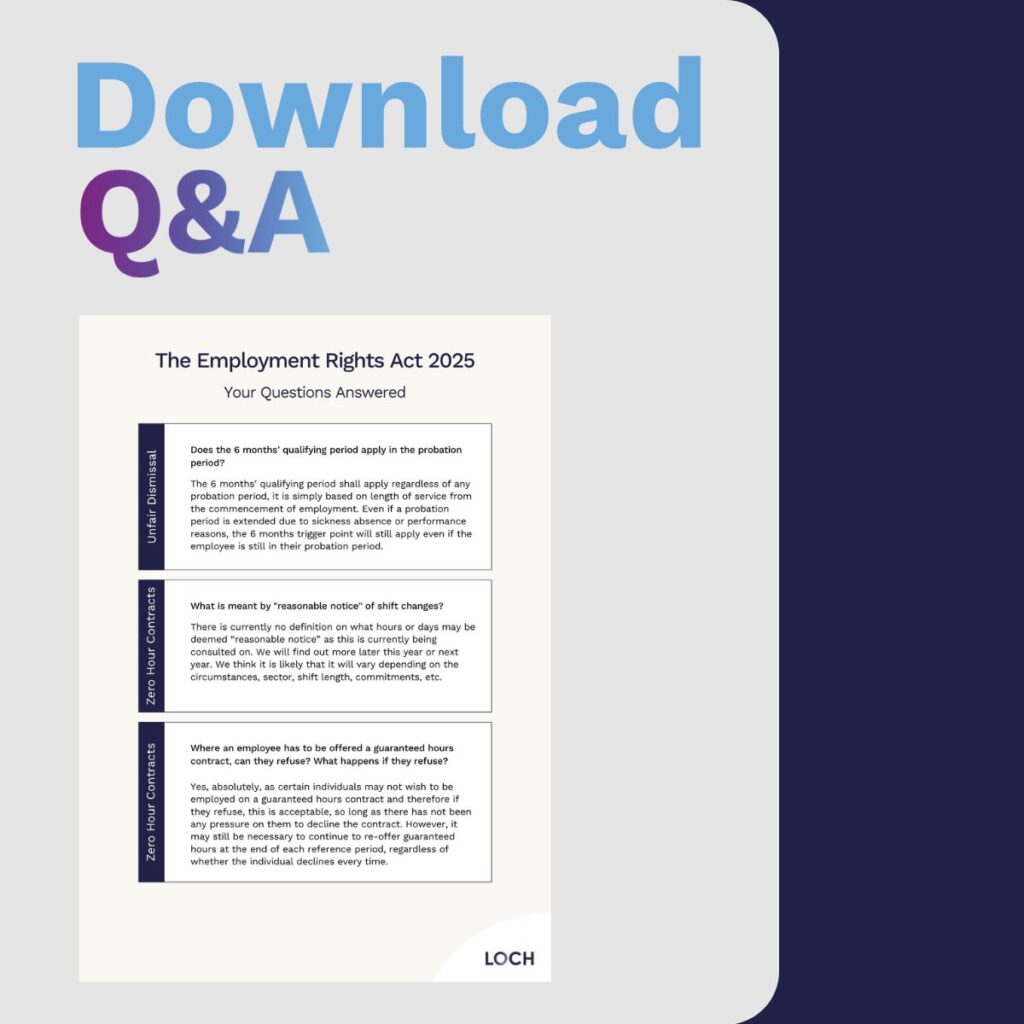
Q&A
During our recent webinar, attendees had the opportunity to ask our experts questions. Here are the answers to those questions.